Money and Shopping Skills for Autistic Children: Parent Guide

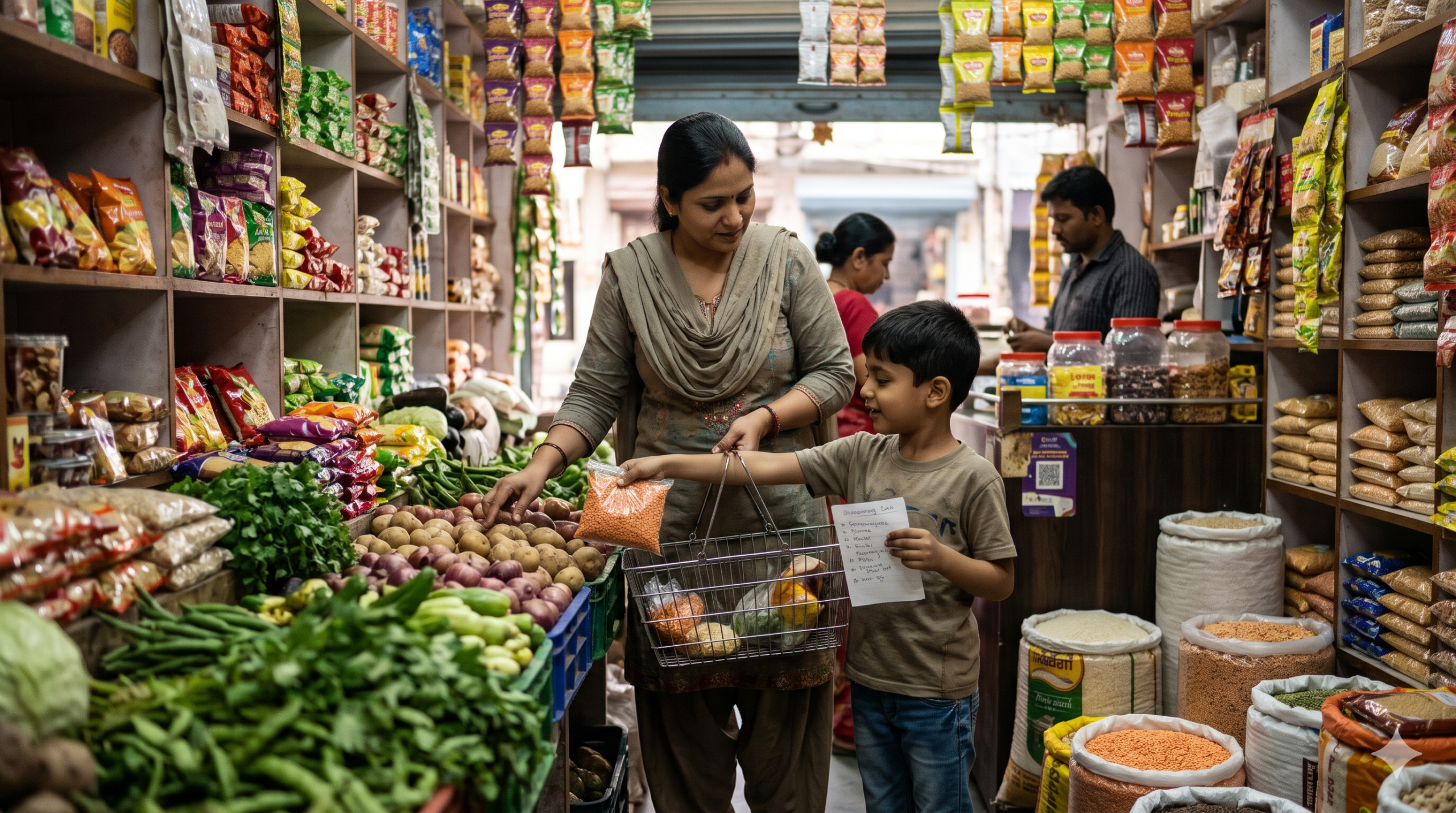
Parent teaching shopping skills to an autistic child

Teaching Money, Shopping and Financial Skills to Autistic Children

“Will my child be able to buy something independently when they grow up?”

Imagine your child visiting a nearby shop, choosing a packet of biscuits, understanding its price, paying the shopkeeper and bringing the item home.

For many parents of autistic children, even this small activity represents an important step towards independence.

Money and shopping skills are not only about mathematics. They also involve making choices, communicating, following instructions, managing belongings and understanding everyday situations.

The good news is that these skills can be taught gradually through practical activities suited to your child’s abilities.

1. Why Do Some Autistic Children Find Money and Shopping Difficult?

Every autistic child has different strengths and support needs.

Some children can perform complex mathematical calculations but struggle to use money in everyday situations. Others may understand shopping routines without being able to count or calculate independently.

Common difficulties include:

  • Recognising different coins and currency notes.
  • Understanding that items have different prices.
  • Calculating how much money is needed.
  • Waiting in a queue or communicating with a shopkeeper.
  • Managing noise, crowds and unfamiliar environments.
  • Understanding the difference between buying something and simply taking it.
  • Keeping money and personal belongings safe.

These difficulties do not mean a child cannot participate in shopping.

The first step is identifying which part of the activity your child can already do and where support is needed.

Before teaching calculations, help your child become familiar with money.

In India, parents can begin with commonly used rupee coins and notes.

Activity: Match the Money

Place a few different coins or notes on a table.

Ask your child to:

  1. Match two identical coins.
  2. Identify a ₹10 note.
  3. Find a ₹20 note.
  4. Separate coins from notes.
  5. Match a price label with the corresponding amount of money.

Begin with just two denominations and introduce more gradually.

For children who need additional support, use large pictures, matching cards or play money.

Parent Tip: Do not insist on counting money immediately. Recognising and matching currency is already a meaningful learning goal.
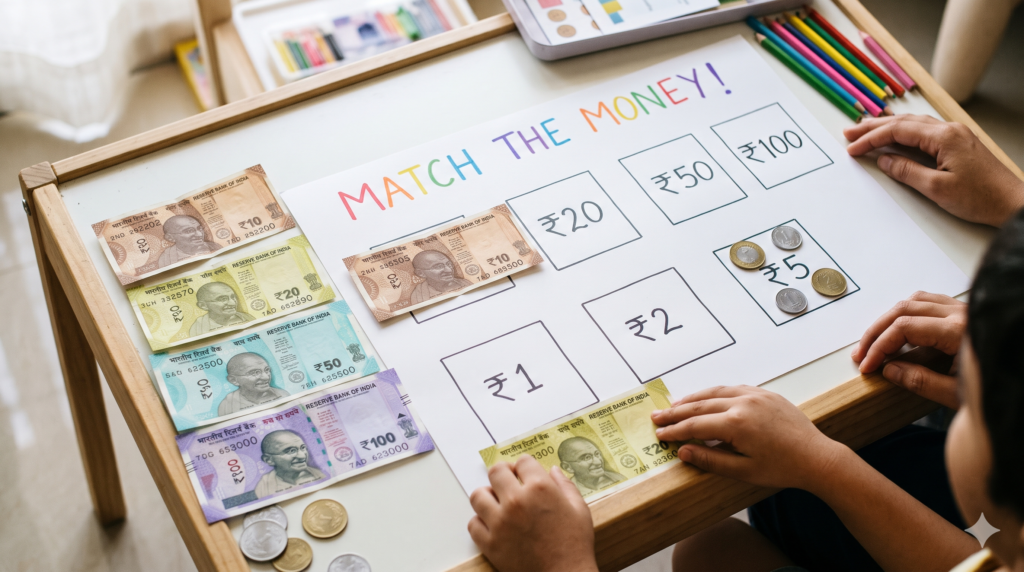
Money recognition activity using Indian rupee notes and coins

Children need to understand that we exchange money for items.

The easiest way to teach this is through pretend shopping.

Activity: Create a Small Shop at Home

Arrange a few familiar items:

Item

Price

Biscuit packet

₹10

Pencil

₹5

Banana

₹10

Notebook

₹20

Use play money initially.

Show your child how to:

  1. Choose an item.
  2. Look at its price.
  3. Give the correct amount.
  4. Receive the item.
  5. Say or communicate “Thank you,” if comfortable.

Take turns being the customer and shopkeeper.

Children who use AAC, gestures or picture cards can participate equally. For example, a child may point to the item and hand over a prepared payment card.

Repeat the activity using different items.

Once your child understands the routine, gradually practise in a real shop with adult supervision.

Start with a familiar, quiet shop rather than a crowded supermarket.

Choose an inexpensive item your child enjoys.

A Simple Six-Step Shopping Routine

Step 1: Take your shopping list and money.

Step 2: Go to the shop with your parent.

Step 3: Find the item.

Step 4: Check its price.

Step 5: Pay the shopkeeper.

Step 6: Collect the item and return with your parent.

You can create a picture card showing these six steps.

Initially, a parent may need to guide the entire activity.

Later, the child might choose the item independently while the parent handles payment.

Eventually, some children may learn to complete additional steps with less assistance.

Remember: The goal is meaningful participation, not rushing towards unsupervised shopping.
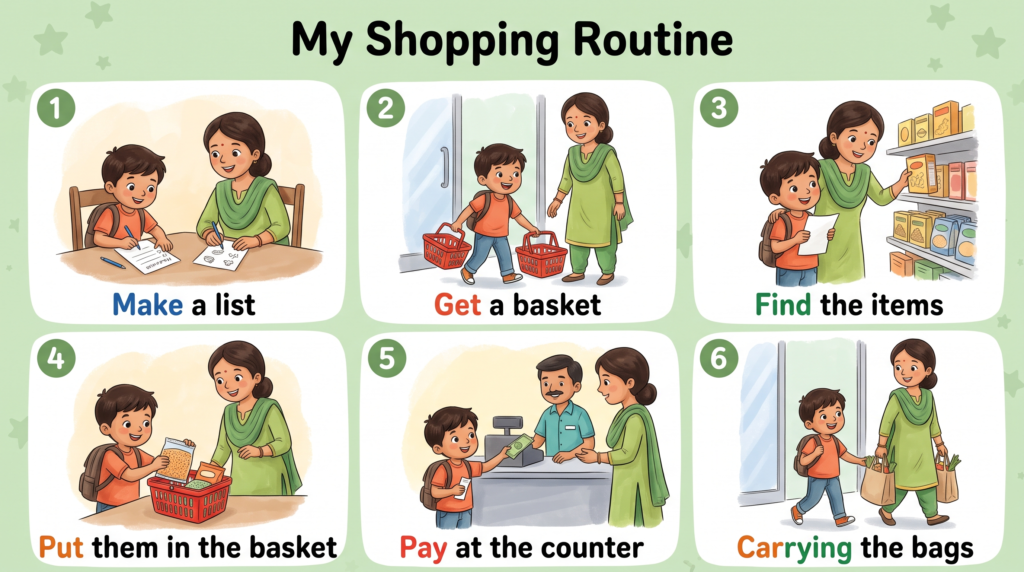
Six-step visual shopping schedule

Parents often worry that their child cannot calculate change.

But not every money skill needs to be taught at the same time.

Begin with simple payments.

Example 1:

A pencil costs ₹10.

Give your child a ₹10 note and practise paying the exact amount.

Example 2:

A notebook costs ₹20.

Help your child recognise that two ₹10 notes make ₹20.

Example 3:

An item costs ₹15.

Practise making ₹15 using a ₹10 note and a ₹5 coin.

Once these skills become familiar, you can introduce larger amounts and receiving change.

For children who find calculations difficult, use calculators, visual price cards or other appropriate supports.

The important question is not simply, “Can my child calculate?”

It is:

“Can my child complete a useful everyday transaction with the right support?”

Money skills also involve learning to make choices.

Start with familiar examples.

Needs: Food, drinking water, essential clothing and necessary school supplies.

Wants: An extra toy, another chocolate or a decorative item.

Explain that wants are not bad. They are things we can choose to buy when money is available.

Activity: Choose Within a Budget

Give your child a pretend budget of ₹50.

Show three items:

  • Colour pencils — ₹30
  • Small toy — ₹40
  • Notebook — ₹20

Ask your child which items they would like to buy.

Use pictures or real objects to help them understand their choices.

For a child who is not ready for calculation, simplify the activity to choosing between two items.

This helps introduce decision-making and the idea that money is limited.
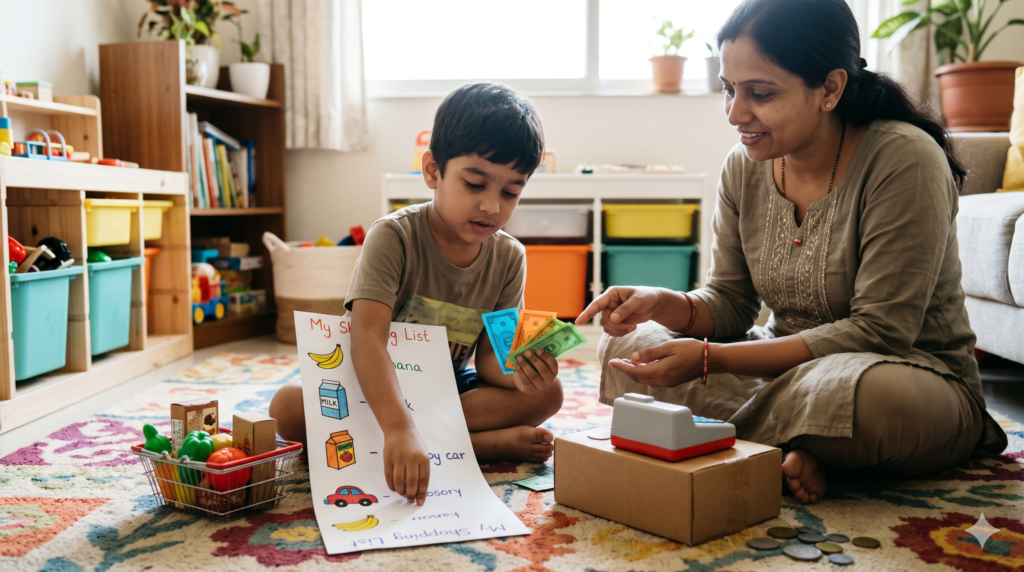
Autistic Child using a picture shopping list and pretend money

Saving is another useful life skill.

Start with a small, meaningful goal.

For example:

Your child wants a colouring book costing ₹100.

Help them place a small amount into a savings box regularly.

Use a visual chart to show progress.

My Savings Goal: Colouring Book — ₹100

Each time money is saved, colour another section of the chart.

Some children may enjoy counting their savings, while others may understand the goal better through pictures.

Saving should be a positive learning experience, not a reason to deny necessary items or punish a child.

In India, many shops accept digital payments through UPI.

As children grow older, it can be useful to understand that money may be paid electronically rather than through cash.

However, financial safety is extremely important.

Begin by explaining:

  • Digital payments involve real money.
  • A QR code may be used to make a payment.
  • Payment amounts must be checked.
  • Passwords, OTPs and UPI PINs must never be shared.
  • Children should ask a trusted caregiver before making unfamiliar payments.

Use demonstrations or mock transactions rather than giving children unrestricted access to bank accounts or payment apps.

A parent should control real transactions until suitable safeguards, understanding and supervision are in place.

Important: Children should never be taught to disclose payment credentials to complete a purchase.

Shopping is a practical activity involving several developmental and functional skills.

Depending on the child’s needs, occupational therapy may help with:

  • Organising materials before leaving home.
  • Following a shopping sequence.
  • Managing a wallet, purse or shopping bag.
  • Using visual supports to complete tasks.
  • Developing attention and planning skills.
  • Managing sensory challenges in community environments.
  • Practising functional activities with parents and caregivers.

For example, a child’s goal might be:

Goal: The child will select an item from a short visual shopping list and place it in a basket during a supervised shopping activity.

As the child progresses, the goal can be adjusted to include identifying a price or participating in payment.

Mathematics instruction, communication therapy, special education and parent teaching may also contribute to developing these skills.

You do not need a complicated assessment to observe everyday progress.

Look for small achievements:

Skill

Example of Progress

Recognising money

Matches ₹10 and ₹20 notes

Understanding prices

Matches an item with its price card

Shopping

Finds an item on a picture list

Paying

Hands over a prepared amount

Communication

Requests an item using speech, gesture or AAC

Saving

Places money into a savings box

Safety

Waits for a caregiver before making a purchase

A child may demonstrate different levels of independence across these activities.

Celebrate progress while continuing to provide appropriate guidance.

Frequently Asked Questions?

1. At what age should I start teaching money skills to my autistic child?

Begin when your child shows interest or is ready to participate in simple activities such as matching, choosing or pretend shopping.

There is no single age that applies to every autistic child.

Not necessarily. Identifying traffic signals is different from recognising moving traffic, checking for turning vehicles and making safe decisions.

Independent road crossing requires consistent real-world safety skills, not just knowledge of rules.

Yes. Some children can learn to select an item, communicate what they want, carry a shopping list or participate in payment using prepared amounts and visual supports.

Participation can develop before independent calculation.

Not until the child can reliably demonstrate the necessary road safety, communication, awareness and decision-making skills.

Being able to buy an item does not automatically mean a child can travel to a shop safely without supervision.

Occupational therapy can support practical shopping routines and related daily living skills. Financial literacy teaching may also involve parents, special educators, teachers and other professionals.

Final Thoughts: Small Shopping Skills Build Everyday Confidence

Money management is not simply about counting coins or performing calculations.

It is about understanding choices, participating in everyday activities and learning to manage practical situations.

For one autistic child, progress may mean recognising a ₹10 note.

For another, it may mean selecting groceries from a shopping list.

For an older child, it might involve managing a small budget with appropriate support.

Independence does not mean doing everything alone. It means being able to participate in life as confidently and safely as possible, with the support that works for the individual.

At Sunshine Kids, our focus is on building meaningful daily living skills that children can practise at home, in school and in their communities.

Research References and Reliable Sources

I verified the guidance against established autism and child-safety resources.

1. Centers for Disease Control and Prevention (CDC)

The CDC explains wandering risks, prevention strategies, identification, emergency planning and safety-skills teaching.

Wandering (Elopement) — CDC

The CDC also reports that, in one parent survey, approximately half of autistic children and youth were reported to have wandered. This is a population-level finding, not a prediction for an individual child. CDC

2. American Academy of Pediatrics (AAP)

The AAP provides guidance on reducing wandering risks, preparing for outings, identification, family supervision plans and water safety.

Keep Kids with Autism Safe from Wandering — AAP

3. National Autistic Society

Its road-safety guide discusses sensory difficulties, clear instructions, visual information and practising safety through games or social stories.

Road Safety: A Guide for Parents and Carers

4. American Academy of Pediatrics — Pedestrian Safety

The AAP recommends supervised practice and explains that most children are not ready to cross streets alone until at least age 10. Some children with disabilities need additional time or support, so readiness must be individually assessed. HealthyChildren.org

Pedestrian Safety Tips for Families

5. Indian Road Safety Guidance

Indian government road-safety guidance reinforces using pedestrian crossings, supervising children and checking traffic before crossing.

Road Safety Tips for Pedestrians — Jharkhand Police

For emergency information:

Government of India Emergency Response System — 112

Ministry of Women and Child Development — Child Helpline 1098