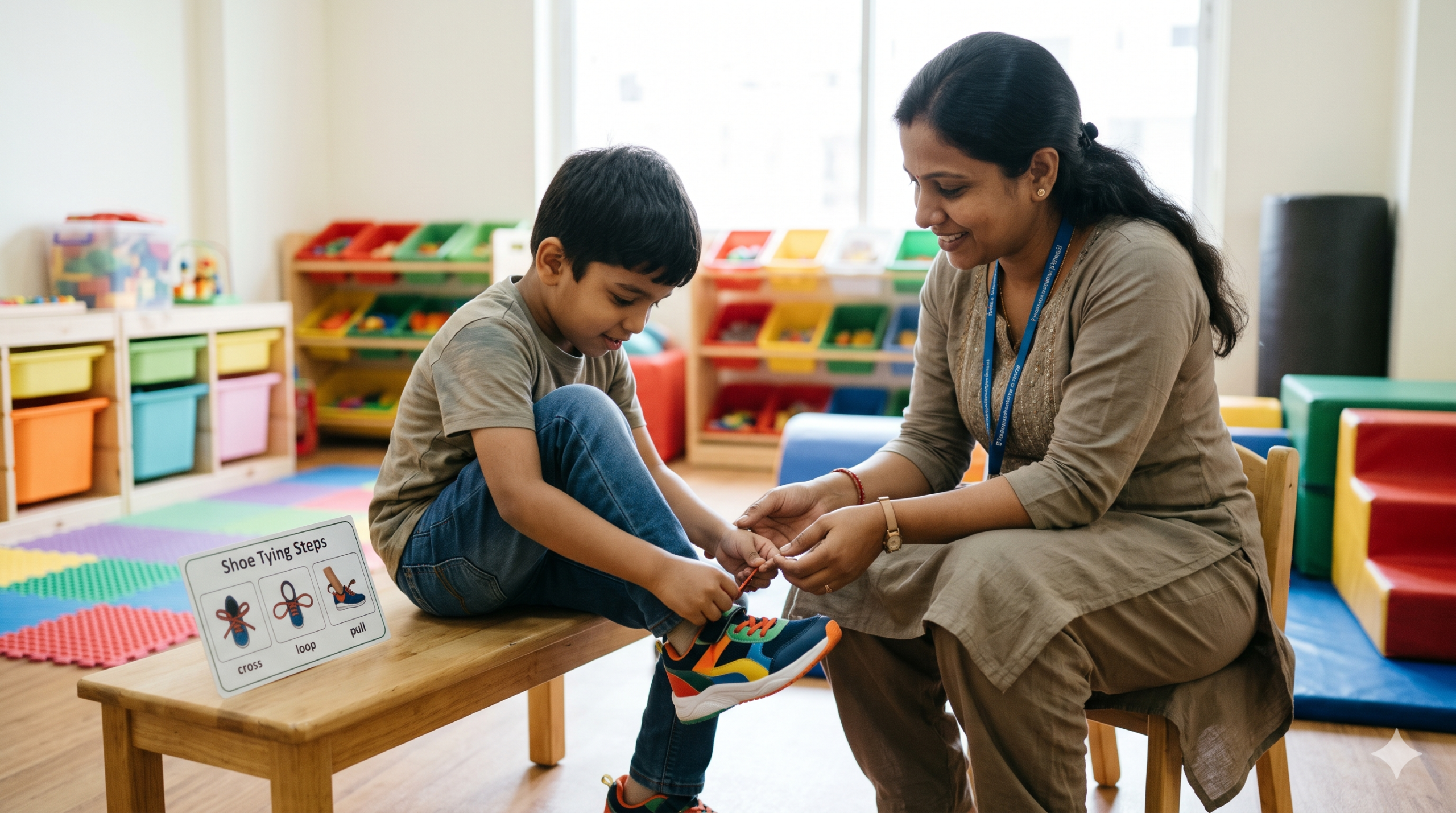
“My child can complete activities during occupational therapy, but why do they still need help with simple things at home?”
This is a common question among parents of autistic children.
Your child may complete puzzles, participate in movement activities or practise hand coordination during therapy.
But as a parent, you may be more concerned about everyday situations:
- Will my child learn to dress independently?
- Can my child brush their teeth?
- Will they be able to use the toilet?
- Can they eat without assistance?
- Will they manage their belongings at school?
- Can they participate safely in everyday activities?
These are exactly the kinds of meaningful goals that occupational therapy can help address.
Occupational therapy is not simply about completing activities in a therapy room. Its purpose is to support participation in everyday life.
Let’s understand how it works.
1. What Is Occupational Therapy for Autistic Children?
Occupational therapy (OT) helps children develop skills and find practical ways to participate in everyday activities.
For children, these activities may include:
- Eating and drinking
- Dressing and undressing
- Toileting and personal hygiene
- Playing and learning
- Managing school materials
- Participating in household routines
- Taking part in community activities
An occupational therapist considers the child’s physical, sensory, cognitive and functional abilities, along with their environment and individual needs.
The aim is not to change who the child is.
The aim is to help the child participate in meaningful activities with greater comfort, confidence and appropriate independence.
2. Why Do Some Autistic Children Struggle With Everyday Tasks?
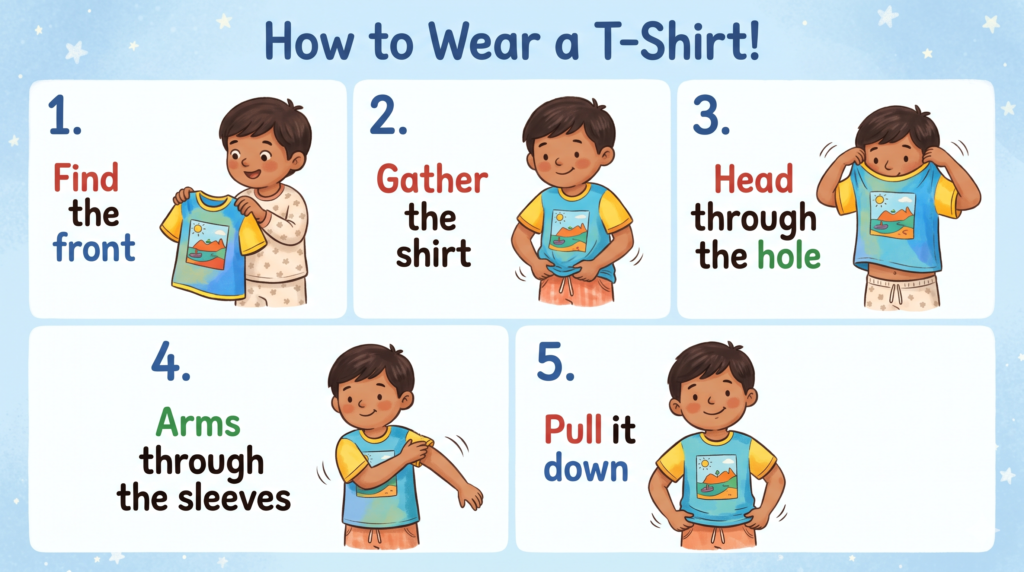
An everyday activity such as putting on a T-shirt may look simple.
But it requires several abilities:
- Understanding the sequence of steps.
- Recognising the front and back of the T-shirt.
- Coordinating both hands.
- Moving arms and shoulders appropriately.
- Understanding where different body parts should go.
- Tolerating the clothing’s texture.
- Staying engaged long enough to complete the activity.
A child may experience difficulty with one or more of these components.
An occupational therapist works to identify the specific barriers rather than assuming every child has the same problem.
For example, one child may need help with hand coordination, while another may already have the necessary motor skills but find certain clothing textures uncomfortable.
The strategies for these two children would be different.
3. How Does Occupational Therapy Help With Daily Living Skills?
Occupational therapy can address several areas of independence.
Daily Living Skill | How Occupational Therapy May Help |
Dressing | Clothing orientation, motor coordination and step-by-step dressing routines |
Toothbrushing | Visual schedules, grip adaptations and managing sensory discomfort |
Toileting | Clothing management, bathroom routines, posture and hygiene skills |
Eating | Utensil use, seating, motor coordination and participation in mealtime routines |
School independence | Managing bags, pencils, lunchboxes and classroom materials |
Household activities | Following routines, organising belongings and completing practical tasks |
Community participation | Planning routines, managing sensory needs and practising functional activities |
These skills are not necessarily taught all at once.
The therapist and family identify the most important goals and gradually work towards them.
For example, if a child is unable to open their lunchbox at school, that may be a more meaningful immediate goal than completing another classroom worksheet.
4. Why Are Sensory Processing and Motor Skills Important?
Some autistic children experience sensory differences.
They may find certain sounds, textures, smells, movements or other sensations uncomfortable or overwhelming.
These experiences can affect everyday activities.
For example:
Toothbrushing: A child may dislike the sensation of bristles or toothpaste.
Bathing: The sound of running water or feeling of shampoo may be uncomfortable.
Dressing: Clothing labels, seams or tight waistbands may cause distress.
Eating: Certain food textures or smells may make mealtimes challenging.
An occupational therapist can identify sensory barriers and suggest practical accommodations.
These may include changing the environment, adjusting materials, preparing the child with visual information or offering acceptable alternatives.
Motor skills are also important.
A child may need support with:
- Hand strength and coordination.
- Using both hands together.
- Balance and posture.
- Body awareness.
- Planning and sequencing movements.
For example, improving coordination may support activities such as using a spoon, opening a container or pulling up trousers.
Sensory activities should always be connected to meaningful functional goals.
Specific sensory-based treatments have varying levels of scientific support. Families should ask what the intervention is intended to improve and how its benefits will be measured in daily life.
5. What Does Goal-Based Occupational Therapy Look Like?
Every child has different abilities, needs and family priorities.
Therefore, therapy goals should be individualised.
Instead of using only broad goals such as “improve fine motor skills,” a therapist can work with parents to identify a functional outcome.
For example:
Parent’s concern: “My child cannot wear their shoes without help.”
Current ability: The child can identify their shoes and place one foot inside but needs help completing the remaining steps.
Functional goal: The child will practise putting on familiar shoes using a visual sequence and gradually reduced assistance.
Therapy activities: Footwear orientation, movement coordination, practising the actual task and identifying any useful adaptations.
Home practice: The parent provides regular opportunities to practise during the child’s normal routine.
Progress review: The therapist checks which steps the child completes and what assistance is still required.
This approach connects therapy directly with the child’s everyday needs.
6. Why Is Parent Training Important?
A child may attend occupational therapy several times a week, but most everyday activities happen at home and school.
That is why parent involvement is so valuable.
Therapists can show parents how to:
- Break a difficult activity into smaller steps.
- Use pictures or visual schedules.
- Demonstrate a task clearly.
- Offer assistance when needed.
- Gradually reduce unnecessary prompts.
- Practise skills during natural daily routines.
For example, a child learning to brush their teeth needs opportunities to practise during the normal morning and evening routine.
The therapist may recommend a visual sequence and demonstrate how to support the child without turning the activity into a stressful experience.
The goal is not to make parents become therapists. It is to help families use practical strategies during ordinary activities.
Home practice should be realistic, respectful and manageable for the family.
7. How Can Parents Measure Progress in Occupational Therapy?
Parents sometimes ask:
“My child has been attending therapy for three months. How do I know whether it is working?”
Progress can be measured through meaningful daily activities.
Consider a child learning to dress.
Stage | Example of Progress |
Starting point | Parent completes most dressing steps |
Early progress | Child participates in selected steps with assistance |
Developing skill | Child completes several steps using pictures or prompts |
Further progress | Child completes the familiar dressing routine with less assistance |
Generalisation | Child uses the skill in more than one everyday setting |
This is an illustrative progression, not a guaranteed timeline.
Progress may also mean reduced distress, better participation, greater comfort or identifying an adaptation that makes an activity accessible.
Parents and therapists should discuss progress regularly and adjust goals when necessary.
8. How Can Monthly Goals Make Therapy More Meaningful?
A practical approach is to identify a small number of priority goals and review them regularly.
For example, a child might work on:
Goal 1 — Dressing: Participate in wearing a T-shirt.
Goal 2 — Eating: Use a spoon during a familiar meal.
Goal 3 — Hygiene: Follow a toothbrushing visual routine.
Goal 4 — School Independence: Open and close a lunchbox.
Goal 5 — Communication: Request help when an activity becomes difficult.
Not every goal belongs to occupational therapy alone. Communication goals may require collaboration with a speech-language therapist, while school-related goals may involve teachers or special educators.
At a monthly review, the team and parents can discuss:
- What the child could do at the beginning.
- Which strategies were used.
- What has improved.
- What remains difficult.
- Whether the goals need to change.
A month may not be enough to achieve a skill. The review is an opportunity to assess and adapt the plan, not a deadline for the child.
This kind of collaboration helps ensure that therapy remains focused on meaningful outcomes.
9. Can Occupational Therapy Make Every Autistic Child Fully Independent?
There is no single answer.
Autistic children have different strengths, developmental profiles and support needs.
Some children may eventually manage many daily activities independently.
Others may continue to need visual instructions, adapted equipment, communication supports or assistance from another person.
This does not mean that therapy has failed.
A child who learns to participate comfortably in bathing with caregiver support has made meaningful progress.
A child who uses a picture card to request assistance has developed a valuable skill.
A child who learns to manage sensory discomfort during a family outing may participate in experiences that were previously difficult.
Independence is not always about doing everything alone. It is about increasing meaningful participation, choice and quality of life with appropriate support.
Frequently Asked Questions?
1. How long does occupational therapy take to show improvement?
It depends on the child’s needs, the goals being addressed, the support provided and opportunities to practise.
Some functional changes may become noticeable relatively early, while other skills require longer-term teaching. No fixed number of sessions guarantees improvement.
2. Does occupational therapy help with speech?
Occupational therapy does not replace speech-language therapy.
However, occupational therapists and speech-language therapists may collaborate on daily activities involving communication, motor skills, sensory needs and participation.
3. My child has good physical abilities. Do they still need occupational therapy?
Possibly, but not necessarily.
A child may have strong gross motor skills while experiencing difficulties with fine motor coordination, self-care, sensory needs or everyday routines.
An individual assessment can help determine whether occupational therapy would be useful.
4. Is sensory integration therapy the same as occupational therapy?
No.
Occupational therapy is a broader profession focused on participation in meaningful activities.
Sensory integration is one specialised approach that may be used within occupational therapy when appropriate. Evidence varies by intervention and outcome, so sensory-related goals should be clearly defined and reviewed.
5. What should parents ask their child's occupational therapist?
You can ask:
- Which daily living skills are we currently working on?
- What can my child already do?
- How will we measure progress?
- What should we practise at home?
- When will we review the goals?
Clear communication between parents and therapists helps keep treatment relevant to everyday life.
Final Thoughts: Therapy Should Make a Difference in Everyday Life
Every parent wants their child to develop the skills needed for a meaningful and fulfilling life.
For some children, this may begin with holding a spoon.
For others, it may mean getting dressed, using the toilet, organising a school bag or participating in family outings.
Occupational therapy can help children practise these functional skills, identify useful adaptations and overcome barriers to everyday participation.
But the most important question is not simply:
“What activities did my child complete during therapy today?”
It is:
“How are these activities helping my child participate more comfortably and independently in everyday life?”
At Sunshine Kids, we believe that meaningful therapy goals should reflect the child’s abilities, the family’s priorities and the everyday activities that matter most.
Because real progress is not only what happens inside a therapy room. It is what becomes possible in everyday life.