A Parent’s Guide to Helping Your Child Become More Independent
Every parent of an autistic child has an important question somewhere in their mind:
“Will my child be able to manage life independently when I am not around?”
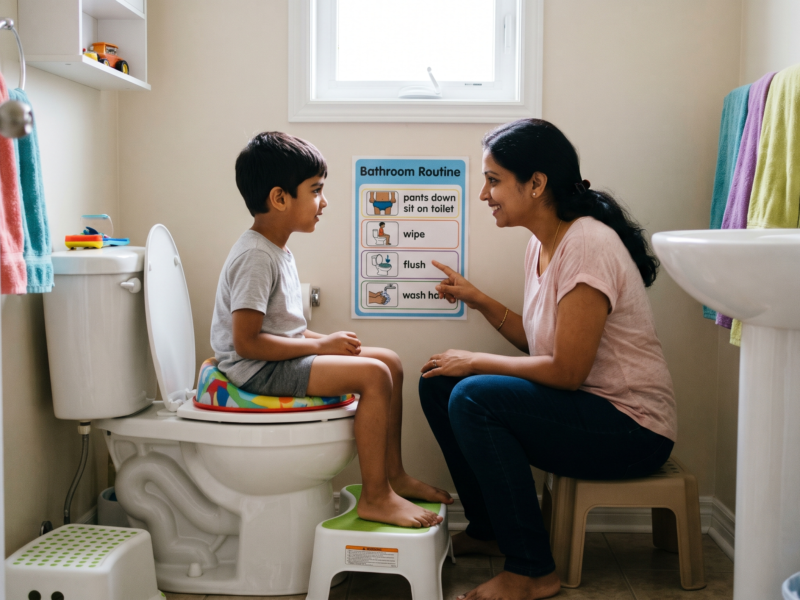
Parents think about everyday activities such as using the toilet, bathing, brushing teeth, getting dressed, eating, carrying a school bag, asking for help and staying safe outside the home.
These may seem like simple activities, but for some autistic children, learning them requires time, practice and the right support.
While communication, learning and behaviour are important areas of development, there is another equally important goal: helping children develop the skills they need to participate in everyday life.
This is where occupational therapy and parent involvement can make a meaningful difference.
1. What Are Independent Living Skills in Autism?
Independent living skills are everyday abilities that help children take care of themselves, manage simple responsibilities and participate in their surroundings.
For autistic children, these skills may include:
- Personal care: Toileting, bathing, brushing teeth and dressing.
- Eating skills: Using a spoon, drinking from a glass and opening lunch boxes.
- Home skills: Keeping belongings in place, following routines and helping with simple household activities.
- School skills: Carrying a school bag, organizing books and managing personal items.
- Communication: Expressing needs, asking for help and communicating discomfort.
- Community skills: Understanding money, shopping, travelling and learning safety rules.
Not every child will develop these skills at the same pace.
Some children may need occasional reminders, while others may require visual instructions, physical adaptations or ongoing assistance.
The goal is not to make every child do everything alone. The goal is to help each child achieve the greatest practical independence possible with appropriate support.
2. Which Daily Living Skills Should Parents Focus On?
Parents sometimes focus on academic learning or speech development and unintentionally overlook everyday functional skills.
However, learning to manage daily activities can improve a child’s participation, confidence and ability to express their needs.
Here are some important areas to work on.
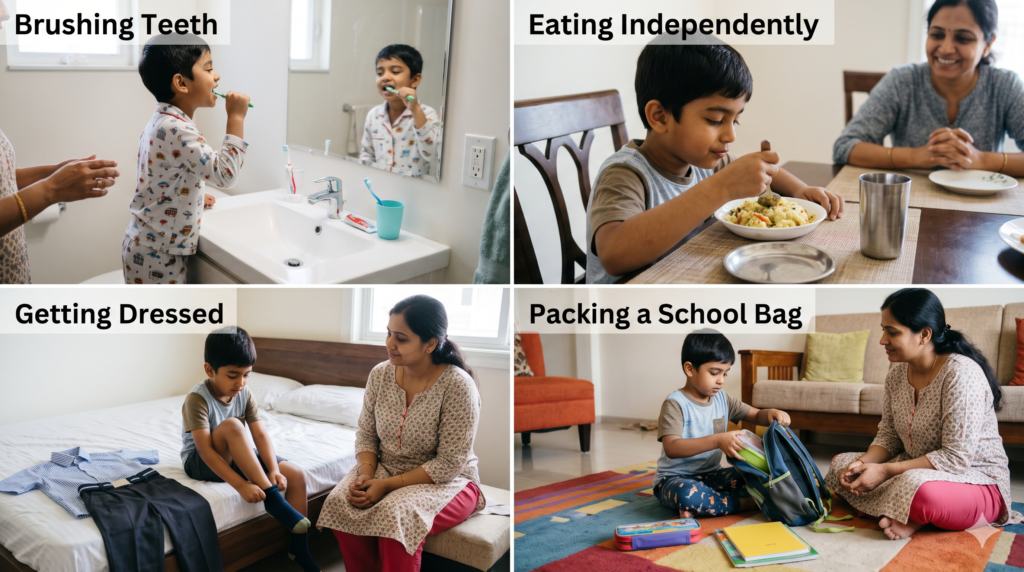
Personal hygiene and self-care
Children can gradually learn to participate in:
- Brushing their teeth.
- Washing their hands and face.
- Taking a bath or shower.
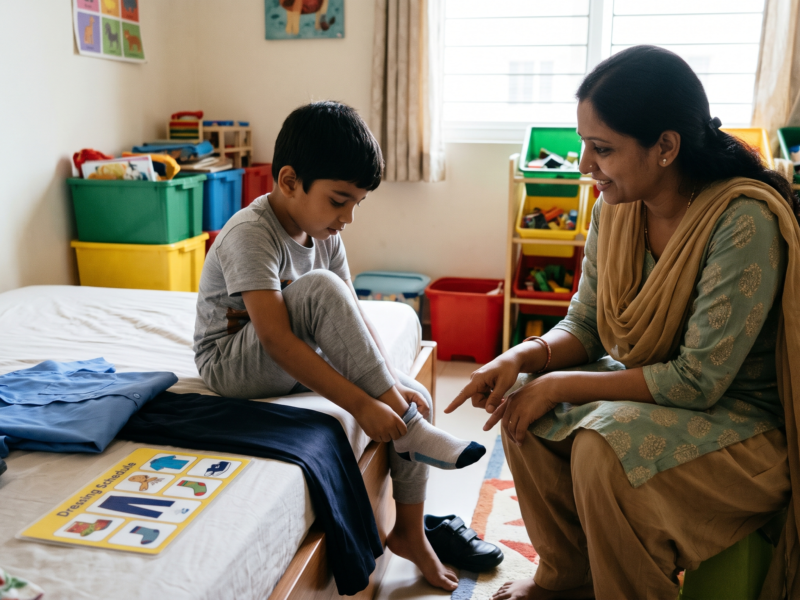
- Wearing and removing clothes.
- Combing their hair.
- Using the toilet and washing their hands afterwards.
Eating and mealtime independence
Useful goals include holding a spoon, drinking water, eating from a plate, opening food containers and communicating when they are hungry or full.
Home and school responsibilities
Children can practise packing their school bags, putting shoes in the correct place, organizing their belongings and following simple morning or bedtime routines.
Communication and asking for help
Independence is not just about physical activities.
A child should also gradually learn ways to communicate:
- “I need help.”
- “I want water.”
- “I need the toilet.”
- “I don’t like this.”
- “I feel uncomfortable.”
These messages can be communicated through speech, gestures, pictures or an AAC device.
3. Why Do Some Autistic Children Find Everyday Activities Difficult?
A child may understand what an activity is but still struggle to complete it independently.
There can be several reasons.
Sensory differences: The sound of a toilet flush, feeling of toothpaste, water temperature or texture of clothing may cause discomfort.
Fine motor difficulties: Holding a toothbrush, fastening buttons, using a spoon or opening packets may require additional coordination.
Motor planning difficulties: Some children find it difficult to understand and organize the sequence of movements required to complete an activity.
Communication differences: A child may not know how to express that they need help, feel uncomfortable or do not understand the next step.
Difficulty with routines and sequencing: A child may complete individual actions but struggle to remember what comes first and what comes next.
Understanding the reason behind the difficulty is important. Instead of repeatedly asking a child to perform an activity, parents and therapists should identify what is making that activity challenging.
4. How Can Parents Teach Independence at Home?
One of the most useful approaches is to break an everyday activity into smaller, manageable steps.
For example, brushing teeth is not just one activity. It involves several steps:
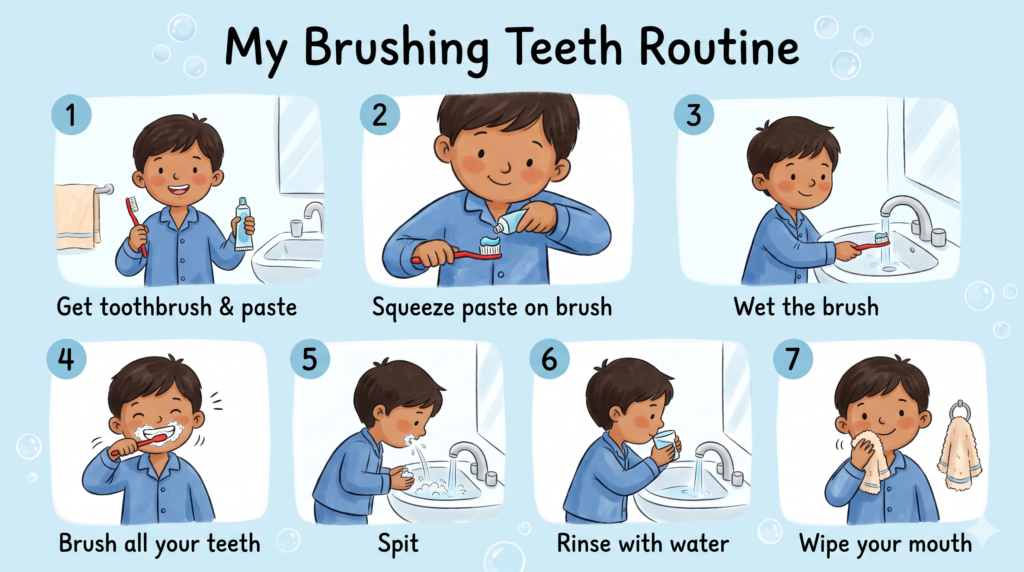
- Go to the bathroom.
- Pick up the toothbrush.
- Apply toothpaste.
- Brush the teeth.
- Rinse the mouth.
- Clean the toothbrush.
- Put everything back.
A child may already know how to brush but still need help remembering the remaining steps.
Parents can use the following strategies:
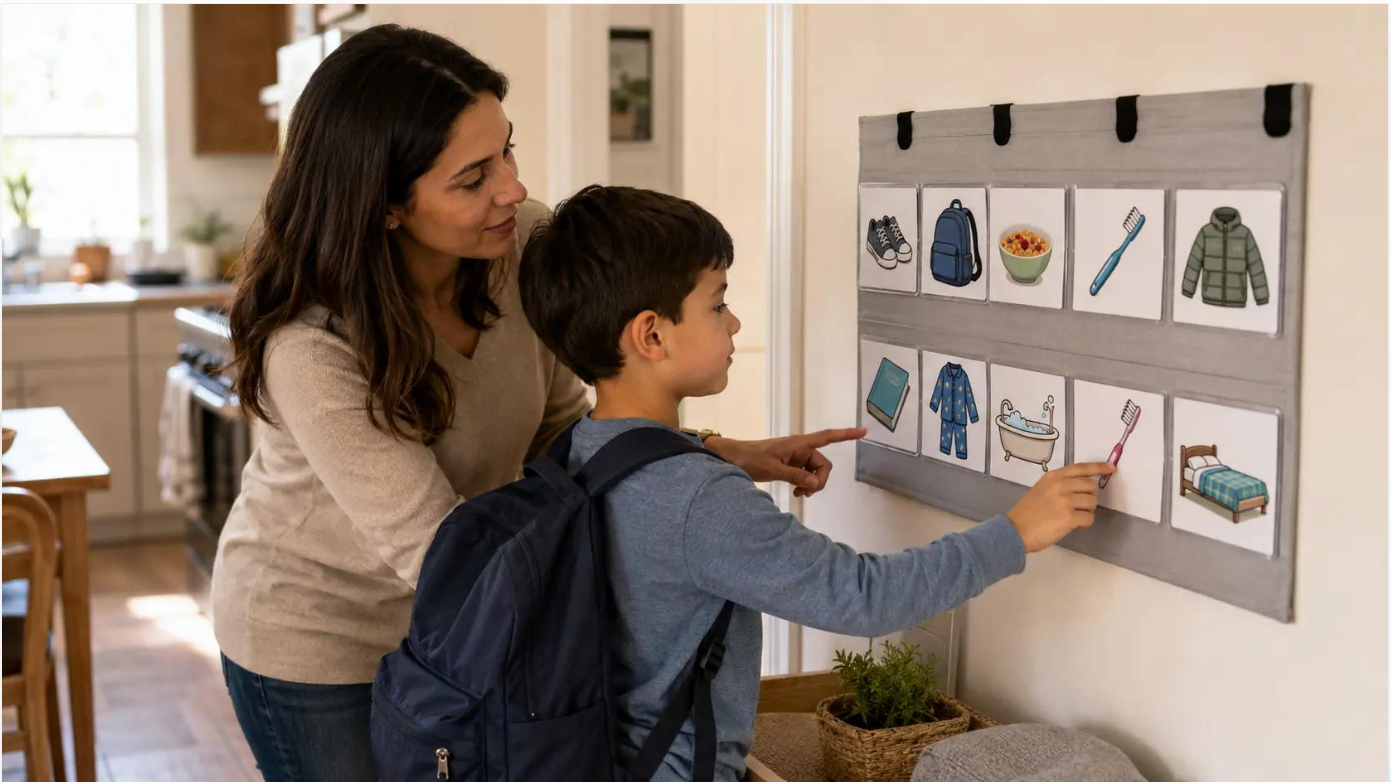
- Use visual schedules: Show pictures of each step.
- Demonstrate the activity: Let the child watch and practise.
- Give simple instructions: Use short, consistent language.
- Allow enough time: Avoid rushing the child through every activity.
- Reduce assistance gradually: Allow the child to complete the steps they can already manage.
- Practise regularly: Repeat the activity in the child’s normal daily routine.
Remember, progress does not always mean completing an entire activity independently. Learning one additional step is also meaningful progress.
5. How Does Occupational Therapy Help Build Independence?
Occupational therapy (OT) focuses on helping children participate in meaningful everyday activities.
An occupational therapist can assess the child’s current abilities and identify difficulties affecting daily living skills.
Depending on the child’s needs, therapy may work on:
- Fine motor coordination and hand strength.
- Sensory processing and tolerance of everyday activities.
- Motor planning and body coordination.
- Dressing, feeding and personal hygiene.
- Following visual instructions and daily routines.
- Completing activities with fewer prompts and less assistance.
The therapist can break an activity into smaller steps, introduce suitable adaptations and help the child practise each step.
According to the American Academy of Pediatrics, occupational therapists can help children with difficulties involving dressing, using utensils and brushing teeth, among other everyday activities.
Importantly, therapy goals should be connected to activities the child actually needs to perform at home, school and in the community.
6. Why Is Parent Training Equally Important?
A child might practise brushing teeth at the therapy centre but struggle to do the same activity at home.
This is why parents should be involved in the learning process.
Therapists can guide parents on:
- Which skills to practise at home.
- How to break activities into smaller steps.
- How much assistance to provide.
- When to reduce prompts.
- How to use visual schedules.
- How to handle frustration without creating unnecessary pressure.
Parents do not need to turn the entire day into a therapy session. Everyday routines provide natural opportunities for learning.
For example, mealtime can become an opportunity to practise using a spoon, opening a lunch box and asking for water.
Research reviews have examined parent-mediated interventions and their effects on adaptive functioning. Findings are encouraging in some areas, although the strength of evidence varies. Consistent family involvement should therefore complement, not replace, individualized professional support.
7. Do Not Forget Community Skills and Personal Safety
Independence also means participating safely outside the home.
As children develop, families can introduce appropriate skills such as:
- Recognizing familiar places.
- Understanding basic road-safety rules.
- Learning to stop and wait.
- Identifying trusted adults.
- Asking for help when lost.
- Recognizing familiar currency.
- Participating in simple shopping activities.
- Learning safe travel routines.
These activities must be taught according to the child’s abilities and safety needs.
Important: Teaching road safety does not mean a child is ready to cross roads independently. Some children will need close supervision and ongoing safety support.
Parents should also have an individualized safety plan if their child is at risk of wandering or moving away from caregivers.
8. How Should Parents Measure Their Child's Progress?
Instead of asking only, “Has my child learned this activity?”, ask:
“How much help does my child still need to complete it?”
For example:
Skill | Progress |
Brushing teeth | Needs physical assistance |
Washing hands | Follows visual instructions |
Eating | Uses a spoon independently |
Dressing | Needs help with buttons |
School bag | Packs belongings with reminders |
This makes it easier for parents and therapists to identify the next achievable goal.
Every child needs an individualized plan. Some may progress quickly in one area and need longer support in another.
9. Independence Is a Journey, Not a Race
There is no single age by which every autistic child must master all daily living skills.
A child who communicates their needs, follows a visual routine, dresses with minimal assistance or knows how to ask for help is making meaningful progress.
Some children will eventually manage many everyday activities independently. Others may continue to need support, adaptations or supervision throughout their lives.
Both deserve opportunities to learn, participate and experience dignity.
At Sunshine Kids, we believe that therapy should not focus only on what a child can learn inside a therapy room. It should also focus on how those skills can help the child in everyday life.
With individualized occupational therapy, appropriate support and parent involvement, we can work towards meaningful improvements in daily living skills, confidence and participation.
Because the ultimate goal is not simply to teach a child to perform an activity.
It is to help every child build the skills and support they need to participate in life as fully as possible.
Frequently Asked Questions
- Can autistic children learn independent living skills?
Yes. Many autistic children can develop daily living skills with individualized teaching, repeated practice, suitable adaptations and support. The level of independence varies from child to child.
- At what age should I start teaching self-help skills?
You can introduce simple self-help activities from early childhood. Skills should be selected according to the child’s developmental abilities, interests and readiness rather than a fixed age.
- Does occupational therapy help with daily living skills?
Yes. Occupational therapy can address difficulties involving fine motor skills, sensory processing, motor planning and everyday activities such as dressing, eating and personal hygiene.
- What if my child understands instructions but does not perform activities independently?
The child may need help with sequencing, motor planning, sensory challenges or remembering the steps. A therapist can assess the barriers and develop an appropriate teaching strategy.
- Can parents teach daily living skills at home?
Yes. Parents can practise skills during everyday routines with guidance from therapists. Consistency, suitable visual supports and gradual reduction of assistance can help.
- Will every autistic child become completely independent?
Not necessarily. Independence looks different for every child. Some may manage most activities alone, while others may need lifelong assistance. The aim is to develop each child’s abilities while respecting their individual support needs.
References and Further Reading
- Patten et al. (2024). Occupational Therapy Practice Guidelines for Autistic People Across the Lifespan. American Journal of Occupational Therapy. https://doi.org/10.5014/ajot.2024.078301
- Conrad et al. (2021). Parent-Mediated Interventions for Children and Adolescents With Autism Spectrum Disorders: A Systematic Review and Meta-Analysis. https://doi.org/10.3389/fpsyt.2021.773604
- American Academy of Pediatrics. Occupational Therapy. https://www.healthychildren.org/English/health-issues/conditions/developmental-disabilities/Pages/Occupational-Therapy.aspx
- Centers for Disease Control and Prevention. Wandering (Elopement). https://www.cdc.gov/child-development/disability-safety/wandering.html
- National Autistic Society. Toileting and Autistic Children. https://www.autism.org.uk/learn/knowledge-hub/professional-practice/toileting
This article provides general educational information. Individual therapy goals and safety decisions should be guided by the child’s abilities and appropriate professional assessment.