
Parent Training for Autism: How to Teach Daily Living Skills at Home
“My child can do something during therapy, but why won’t they do the same thing at home?”
This is a question many parents of autistic children ask.
Your child may successfully wear their shoes, use a spoon or follow instructions during therapy, but still need assistance with the same activities at home.
This does not necessarily mean the child has forgotten the skill.
Sometimes, children need additional practice to use a newly learned skill in different environments.
The encouraging part is that everyday family routines can provide valuable learning opportunities.
You do not need to turn your home into a therapy centre. Small opportunities during normal daily activities can help your child develop meaningful independence.
Let’s understand how.
1. Why Is Parent Training Important for Autistic Children?
A child spends only part of their week attending therapy.
Most daily living activities happen at home, school and in the community.
For example:
- Dressing happens every morning.
- Brushing teeth happens daily.
- Eating provides opportunities to practise utensils and communication.
- Packing a school bag is part of the school routine.
- Putting toys away can develop organisation skills.
When parents understand how to support these activities, children have more opportunities to practise skills in meaningful situations.
Research on caregiver-implemented interventions suggests that structured strategies, including task analysis and prompting, can help some children and individuals with developmental disabilities learn daily living skills. Results vary according to the individual and intervention.
Parent training is not about making parents responsible for providing professional therapy. It is about helping families use practical strategies that fit their everyday lives.
2. Start With One Important Daily Living Skill
Parents sometimes feel overwhelmed because their child needs help with several activities.
Rather than working on everything at once, begin with one meaningful goal.
Ask yourself:
“Which everyday activity would make the biggest positive difference for my child and our family?”
It might be:
- Wearing shoes.
- Opening a lunchbox.
- Washing hands.
- Brushing teeth.
- Using a spoon.
- Putting school materials into a bag.
- Asking for help.
Choose something appropriate for your child’s current abilities.
For example:
Current ability: Your child can remove their shoes but cannot put them on.
First goal: Help your child learn to place their feet into familiar shoes.
Once this becomes easier, introduce another step.
A small, achievable goal is often more useful than several difficult goals introduced together.
3. Break Every Activity Into Small Steps
Many daily activities involve several smaller actions.
Consider brushing teeth.
The complete activity includes:
- Pick up the toothbrush.
- Put toothpaste on it.
- Brush the teeth.
- Spit out the toothpaste.
- Rinse the toothbrush.
- Put it away.
Your child may be able to complete some steps but require assistance with others.
Instead of saying:
“Brush your teeth independently.”
Try teaching one part of the routine at a time.
A Useful Technique: Learning the Last Step First
Some children benefit from completing the final step of an activity while an adult assists with the earlier steps.
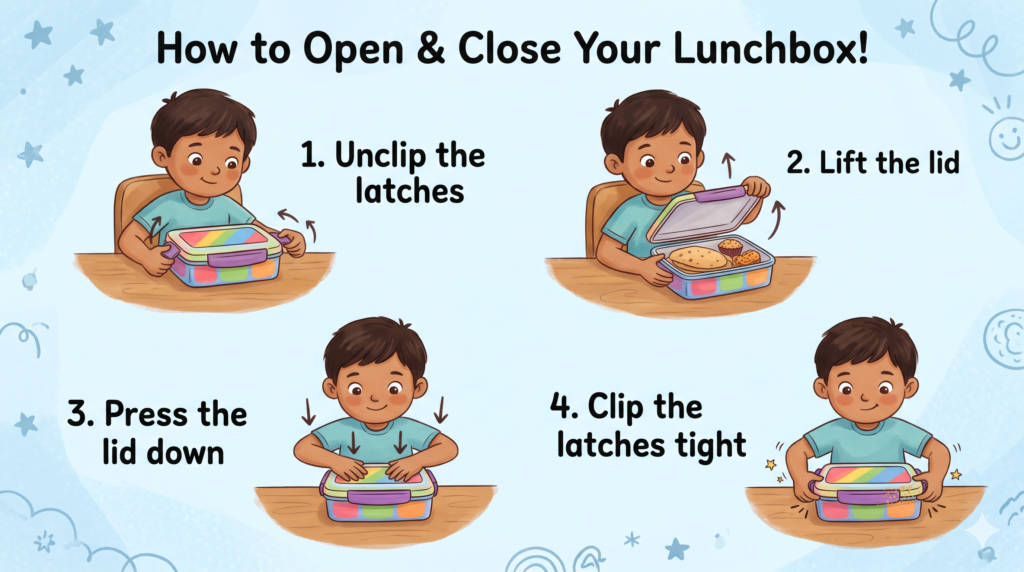
For example, when putting away a lunchbox:
Initially, the parent completes most steps and the child places the lunchbox into the school bag.
Later, the child closes the lunchbox and puts it into the bag.
Gradually, the child may learn more steps.
This approach is sometimes called backward chaining.
Different children benefit from different teaching approaches, so the method should be chosen according to the child’s needs.
4. Use Visual Schedules to Make Daily Routines Easier
Some autistic children understand pictures, written instructions or demonstrations more easily than spoken directions.
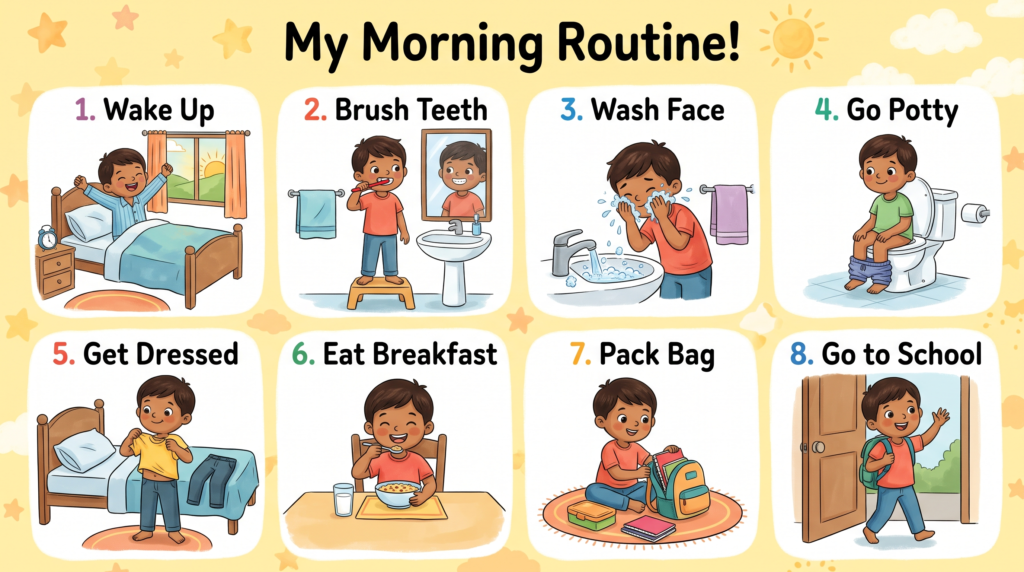
A visual schedule can help them understand what to do next.
Example: Morning Routine
Step | Activity |
1 | Use the toilet |
2 | Brush teeth |
3 | Get dressed |
4 | Eat breakfast |
5 | Pack school bag |
You can use photographs of your child, simple picture symbols or written words.
Place the schedule somewhere easy to see.
As each activity is completed, your child can tick it off or move the picture to a Finished section.
Visual schedules should match the child’s understanding and preferences. They are helpful tools for many children, but not every autistic child needs or enjoys them.
Parent Tip: Start with a short schedule containing two or three activities rather than introducing a complicated chart immediately.
5. How Much Help Should Parents Give?
One common difficulty is deciding when to help and when to allow the child to try.
If parents complete every activity immediately, the child may have fewer opportunities to participate.
However, giving too little assistance may cause frustration or make the activity unsafe.
A useful approach is:
Show → Support → Wait → Encourage
Show: Demonstrate the activity.
Support: Provide a clear picture, verbal instruction or other suitable prompt.
Wait: Allow your child time to process and respond.
Encourage: Acknowledge their effort and participation.
For example, when your child is learning to wear shoes, you may initially demonstrate how to open the shoe and guide them through the sequence.
Later, you might point to the shoe instead of repeating instructions.
Eventually, your child may complete the familiar step with less assistance.
This gradual reduction of unnecessary prompts is called prompt fading.
Important: Do not force a child’s hands or body through an activity. Physical assistance should be respectful, appropriate, agreed upon wherever possible and stopped if it causes distress.


6. Make Practice Part of Everyday Life
Children do not always need separate training sessions to practise daily living skills.
Instead, use natural opportunities.
Daily Routine | Skill to Practise |
Morning dressing | Wearing clothes and shoes |
Breakfast | Using a spoon or cup |
Before school | Packing a bag |
After school | Keeping belongings in the correct place |
Snack time | Opening containers and asking for help |
Evening | Putting toys away |
Bedtime | Following a hygiene routine |
Choose activities that are safe and manageable.
For example, opening a lunchbox during snack time may provide a better learning opportunity than practising the same task repeatedly when the child is tired.
Consistency matters, but flexibility matters too.
On difficult days, it is fine to provide more support or take a break.
7. What If My Child Refuses to Practise?
Sometimes a child may resist a daily activity.
Before assuming the child is being uncooperative, consider why the task is difficult.
Possible reasons include:
- Sensory discomfort.
- Pain or physical difficulty.
- Fatigue.
- Confusing instructions.
- Anxiety about the activity.
- Too many steps.
- Lack of interest or choice.
For example, a child who avoids toothbrushing may dislike the toothpaste flavour or toothbrush texture.
Changing the toothpaste or using a different toothbrush may be more effective than repeatedly insisting on the activity.
Offer manageable choices when possible.
“Would you like the blue toothbrush or the green one?”
If your child becomes distressed, reduce the demand, identify the difficulty and adjust the approach.
Teaching independence should not involve punishment, intimidation or forcing a child through overwhelming experiences.
Persistent pain, feeding difficulties, severe distress or other concerning symptoms may require professional assessment.
8. How Can Parents and Therapists Work Together?
Parents should not have to guess which skills to practise at home.
A useful approach is for parents and therapists to agree on a small number of functional goals.
For example:
Goal | Therapy Strategy | Home Practice |
Wearing shoes | Visual sequence and motor practice | Practise before going outside |
Opening lunchbox | Grip and coordination activities | Practise during snack time |
Handwashing | Step-by-step visual routine | Practise after toilet use |
Asking for help | Functional communication teaching | Encourage requests during everyday activities |
At regular reviews, parents can share:
- Which activities the child can now complete.
- Where assistance is still needed.
- Which strategies are working.
- Whether a task causes distress.
- Which goals matter most to the family.
Occupational therapists, speech-language therapists, special educators and other professionals can coordinate their approaches when relevant.
The purpose of collaboration is to make therapy strategies useful in daily life—not to increase pressure on parents.
9. How Can I Track My Child's Progress at Home?
You do not need a complicated progress report.
A simple weekly observation sheet can help.
Example: Learning to Open a Lunchbox
Week | Observation |
Week 1 | Needs assistance with opening and closing |
Week 2 | Opens with a demonstration and some assistance |
Week 3 | Opens using a picture prompt |
Week 4 | Opens familiar lunchbox with minimal assistance |
This is an illustration, not an expected four-week timeline.
Your child’s progress may be faster, slower or uneven.
You can also record whether the child feels comfortable, participates willingly and uses the skill in different situations.
Progress is not only completing a task without help. It can also mean needing less assistance, using an adaptation or participating with greater comfort.
Frequently Asked Questions?
1. How much time should I spend teaching life skills at home?
There is no fixed duration that suits every child.
Begin with brief opportunities during activities that already happen each day. Even practising one part of a routine can be valuable.
2. Should I make my child practise even when they refuse?
Try to understand the reason for refusal.
Pain, sensory discomfort, fear and fatigue should be addressed rather than ignored. Adjust the activity and seek professional advice when needed.
3. My child can do something at therapy but not at home. Why?
Skills learned in one setting may need additional practice before they can be used elsewhere.
Different instructions, materials, routines or environments may affect performance.
Ask your therapist how to support the same skill at home.
4. Can non-speaking autistic children learn daily living skills?
Yes.
Children may learn through demonstrations, visual supports, gestures, written instructions or AAC.
Spoken language is not a requirement for developing functional independence.
5. What if my child continues to need assistance?
Some autistic children will require ongoing support for certain activities.
Adaptations, visual instructions, assistive technology and caregiver assistance can all support meaningful participation.
The goal should reflect the child’s needs and quality of life, not an expectation that everyone must do every activity alone.
Final Thoughts: Everyday Opportunities Can Build Meaningful Independence
For parents, teaching life skills can sometimes feel like an additional responsibility.
But helping your child develop independence does not have to involve complicated activities or strict training schedules.
It may begin with allowing your child to place their shoes near the door.
Opening a lunchbox.
Putting a plate in the sink.
Using a picture to ask for help.
Or completing one more step of a familiar routine.
Small achievements in everyday life can become the foundation for greater confidence and participation.
At Sunshine Kids, we believe that parents and therapists can work together to identify meaningful goals, develop practical strategies and celebrate each child’s individual progress.
Because the purpose of therapy is not simply to learn a skill—it is to make that skill useful in everyday life.