How to Teach Dressing Skills to Autistic Children
Getting dressed is an everyday activity, but it involves several skills: understanding the order of clothing, balancing, coordinating both hands, identifying front and back, managing fasteners and tolerating different textures.
Some autistic children learn these skills easily, while others need more time, repetition and support. A child may be able to put on a T-shirt but struggle with buttons, socks or choosing clothes suitable for the weather.
The aim is not to make every child dress independently by a particular age. It is to help each child participate as much as possible, with the right level of support.
1. Why can dressing be difficult for autistic children?
Dressing is not just a physical task. It involves sensory, motor, communication and thinking skills.
Some common challenges include:
Sensory sensitivities: Clothing labels, seams, tight waistbands, rough fabrics or certain materials may feel uncomfortable.
Motor coordination: Pulling up trousers, putting an arm through a sleeve, balancing on one leg or managing buttons can be difficult.
Body awareness: A child may struggle to identify where an arm or leg needs to go.
Sequencing: Remembering which clothing item comes first and what to do next can be challenging.
Understanding clothing: Identifying the front and back, inside and outside, or matching clothes to the weather may require teaching.
Changes in routine: Wearing unfamiliar clothes or changing from a preferred outfit may cause distress.
Understanding the reason behind the difficulty helps parents choose the right strategy.
2. Start with the clothing your child already likes
Before teaching new dressing skills, make the activity comfortable.
Try:
Soft cotton clothes and familiar fabrics.
Removing irritating labels where possible.
Choosing elastic waistbands and loose-fitting clothes initially.
Trying seamless or comfortable socks if seams cause discomfort.
Offering two suitable clothing choices instead of overwhelming your child with many options.
If your child strongly prefers one particular outfit, introduce a similar alternative gradually. Avoid turning clothing changes into a daily struggle.
3. Break dressing into small steps
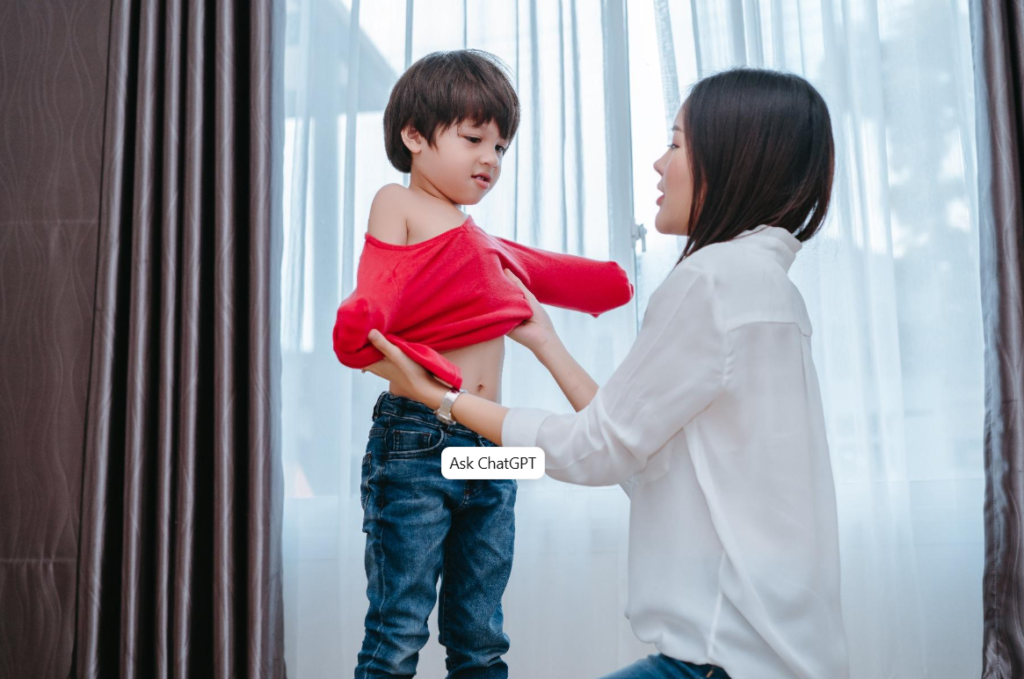
Instead of expecting your child to get completely dressed at once, divide the activity into manageable parts.
For example, putting on a T-shirt involves:
Pick up the T-shirt.
Find the neck opening.
Put the head through.
Find one sleeve.
Put one arm through.
Put the other arm through.
Pull the T-shirt down.
Teach one or two steps at a time. Your child may already know some steps, so focus on the ones that need practice.
Use the steps your child can already do
If your child can put their arms through the sleeves but cannot pull the shirt down, let them complete the familiar steps and practise only the final step.
This builds participation without making the whole activity unnecessarily difficult.
4. Teach one clothing skill at a time
Start with simple clothing and gradually introduce more complex tasks.
| Skill | A helpful starting point |
|---|---|
| Removing clothes | Practise pulling off loose T-shirts or elastic-waist trousers |
| Wearing a T-shirt | Use a loose, familiar T-shirt |
| Wearing trousers | Start with elastic-waist shorts or pyjamas |
| Socks | Practise pulling on loose, comfortable socks |
| Shoes | Begin with easy-to-open footwear |
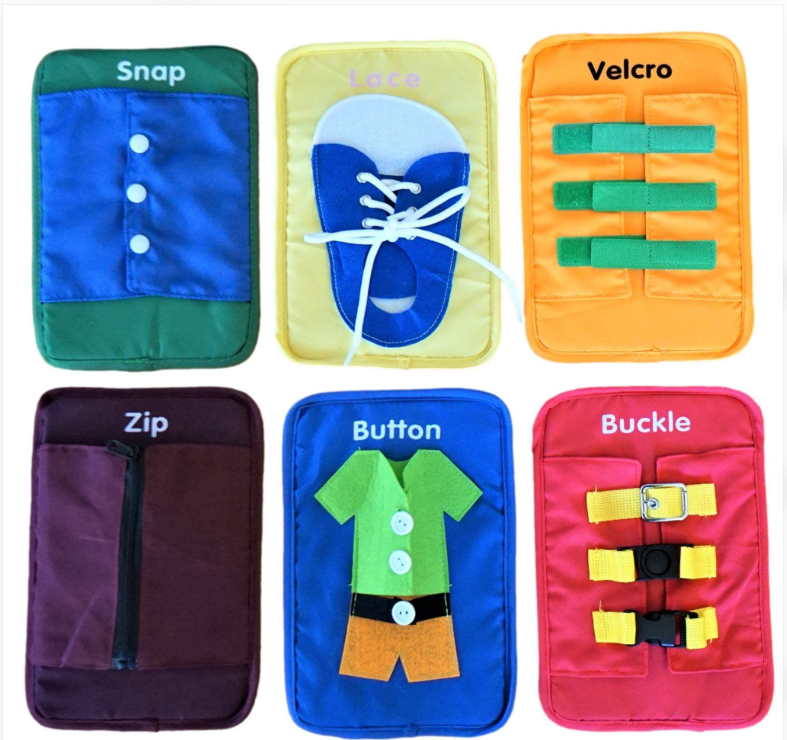
| Buttons | Practise with large buttons on a dressing board or loose garment |
| Zippers | Start with a large zipper on a jacket or practice item |
| Shoelaces | Introduce later, when the child is ready for the hand coordination involved |
Your child does not need to master every fastener. Adapted clothing, elastic laces, Velcro shoes and other practical options can support independence.
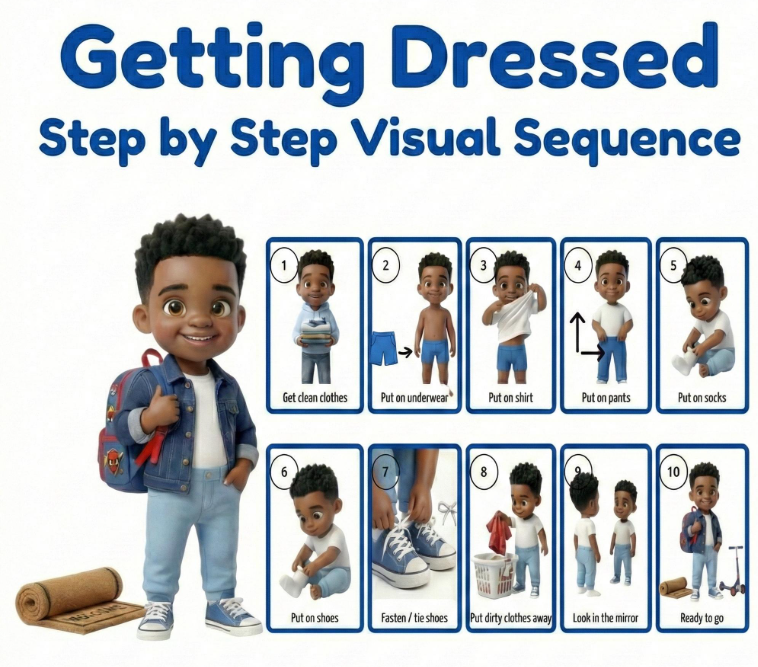
5. Use visual schedules and demonstrations
Some children understand pictures more easily than long verbal instructions.
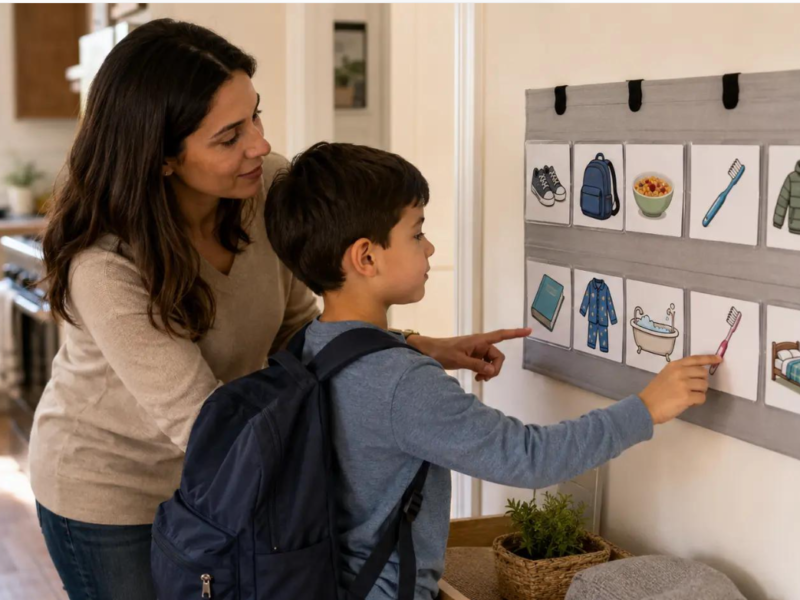
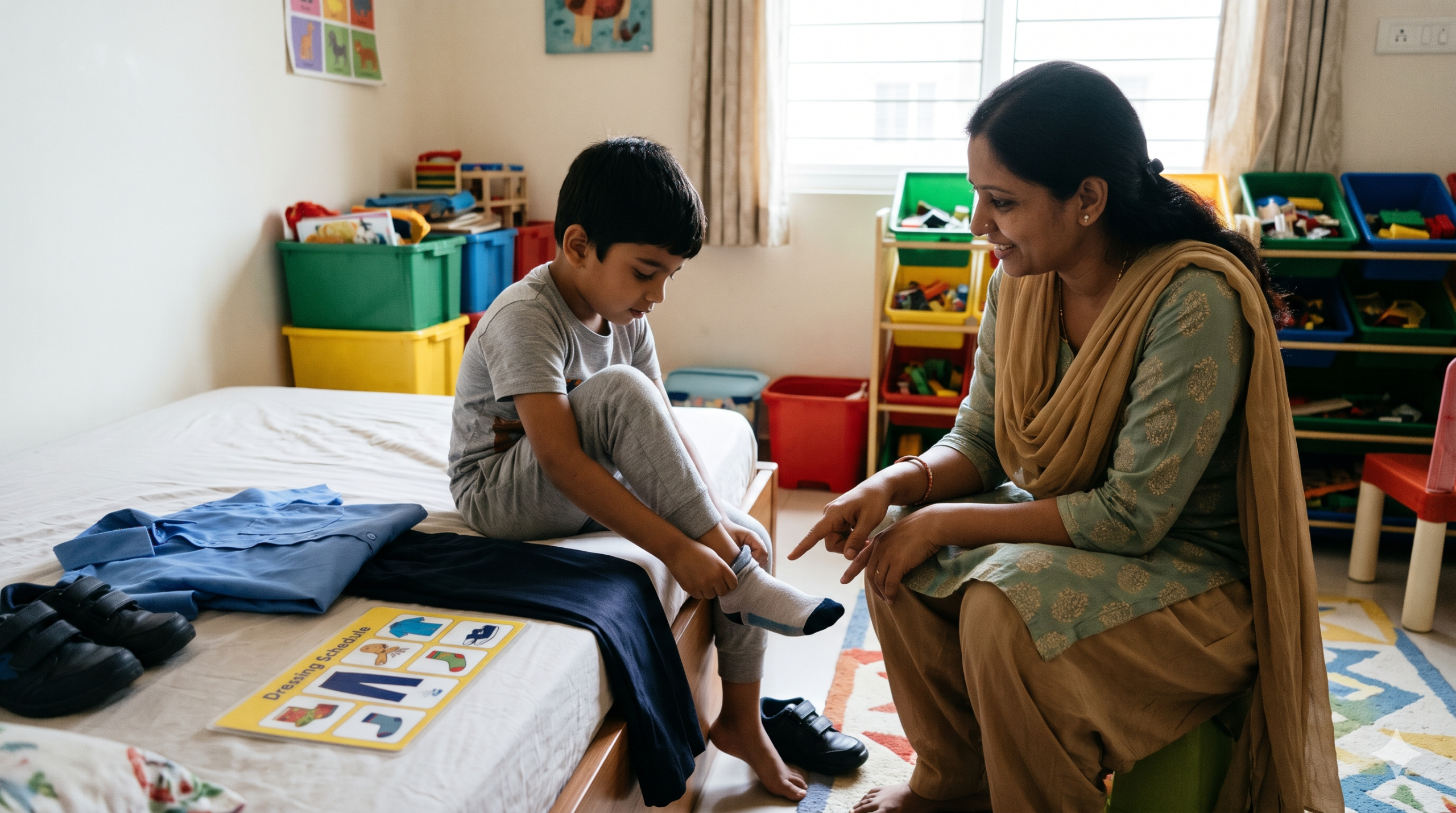
Create a simple dressing chart with photographs or illustrations:
Wear underwear.
Put on a vest or undershirt, if worn.
Put on a shirt or T-shirt.
Put on trousers or a skirt.
Wear socks.
Put on shoes.
Place the chart near the dressing area. Point to the next picture rather than repeating instructions many times.
You can also demonstrate the task, use a mirror or make a short video of the steps. Choose whichever method your child understands best.
A 2024 study comparing picture and video prompts found that both types of visual support helped many autistic participants improve daily living task completion. The most useful format can differ from child to child.
6. Practise when there is no hurry
Morning routines can be stressful when everyone is getting ready for school or work.
Instead:
Practise after school, in the evening or on weekends.
Keep the clothing sequence predictable.
Lay clothes out in the order they will be worn.
Let your child sit while putting on socks and shoes if balance is difficult.
Use short, familiar instructions.
Give enough time for your child to attempt each step.
You can also practise through play: dressing a doll, playing dress-up or putting on a jacket before going outside.
7. Help without taking over
A common challenge for parents is knowing when to help and when to wait.
Try a gradual approach:
First, give your child time to attempt the step.
If needed, give a short verbal instruction.
Then point to the relevant part or show a picture.
Demonstrate the movement.
Offer physical assistance only when necessary and comfortable for the child.
Reduce help gradually as the child learns. Respect your child’s comfort and preferences; avoid forcing their hands or body through a movement.
Remember, success does not always mean completing the entire task alone. Choosing clothes, putting one arm through a sleeve or pulling up trousers are meaningful steps towards participation.
8. How can occupational therapy help?
Occupational therapy can help identify which parts of dressing are difficult and why.
Depending on the child’s needs, an occupational therapist may work on:
Fine motor skills needed for buttons, zippers and laces.
Bilateral coordination, using both hands together.
Balance and body awareness.
Motor planning and movement sequences.
Sensory-related clothing difficulties.
Visual schedules and practical adaptations.
Practising dressing in a way that can be continued at home.
At Sunshine Kids, dressing can be included in an individual child’s daily living goals when it is relevant to their needs. Parents can also learn how to practise the same steps at home.

9. How should parents measure progress?
Look beyond whether your child can dress completely alone.
You can observe progress in smaller ways:
| Area | Progress to notice |
|---|---|
| Participation | Helps during dressing instead of avoiding the whole activity |
| Understanding | Recognises the next step |
| Upper-body dressing | Puts head or arms through clothing |
| Lower-body dressing | Pulls up elastic-waist trousers |
| Fasteners | Opens or closes a simple fastener |
| Choices | Selects between suitable clothing options |
| Routine | Completes more steps with fewer reminders |
A child may make progress in one area while still needing help in another. That is completely reasonable.
Frequently Asked Questions?
1. At what age should an autistic child dress independently?
There is no single age that applies to every autistic child. Skills depend on the child’s development, motor abilities, sensory needs, understanding and opportunities to practise.
2. My child can dress but refuses certain clothes. What should I do?
First check whether the fabric, label, fit, temperature or other sensory features are uncomfortable. Offer suitable alternatives and introduce new clothing gradually.
3. Should I teach buttons and shoelaces first?
Not necessarily. Start with the dressing skills that are useful in your child’s everyday routine. Easier fasteners and adapted clothing are perfectly acceptable.
4.Should I use hand-over-hand assistance?
Do not force physical guidance. Try demonstration, pictures, gestures and verbal prompts first. If physical assistance is needed, make sure it is comfortable, respectful and appropriate for your child.
5. Can occupational therapy improve dressing skills?
Occupational therapy can help identify barriers and develop practical strategies for dressing, coordination, motor planning and sensory-related challenges.
A final message for parents
Dressing independently is a skill that develops through practice, patience and the right support.
Do not compare your child’s progress with another child’s. Celebrate small achievements: putting on one sock, pulling up trousers, choosing a T-shirt or remembering the next step.
The goal is not perfect dressing. The goal is greater participation, comfort, confidence and independence in everyday life.